
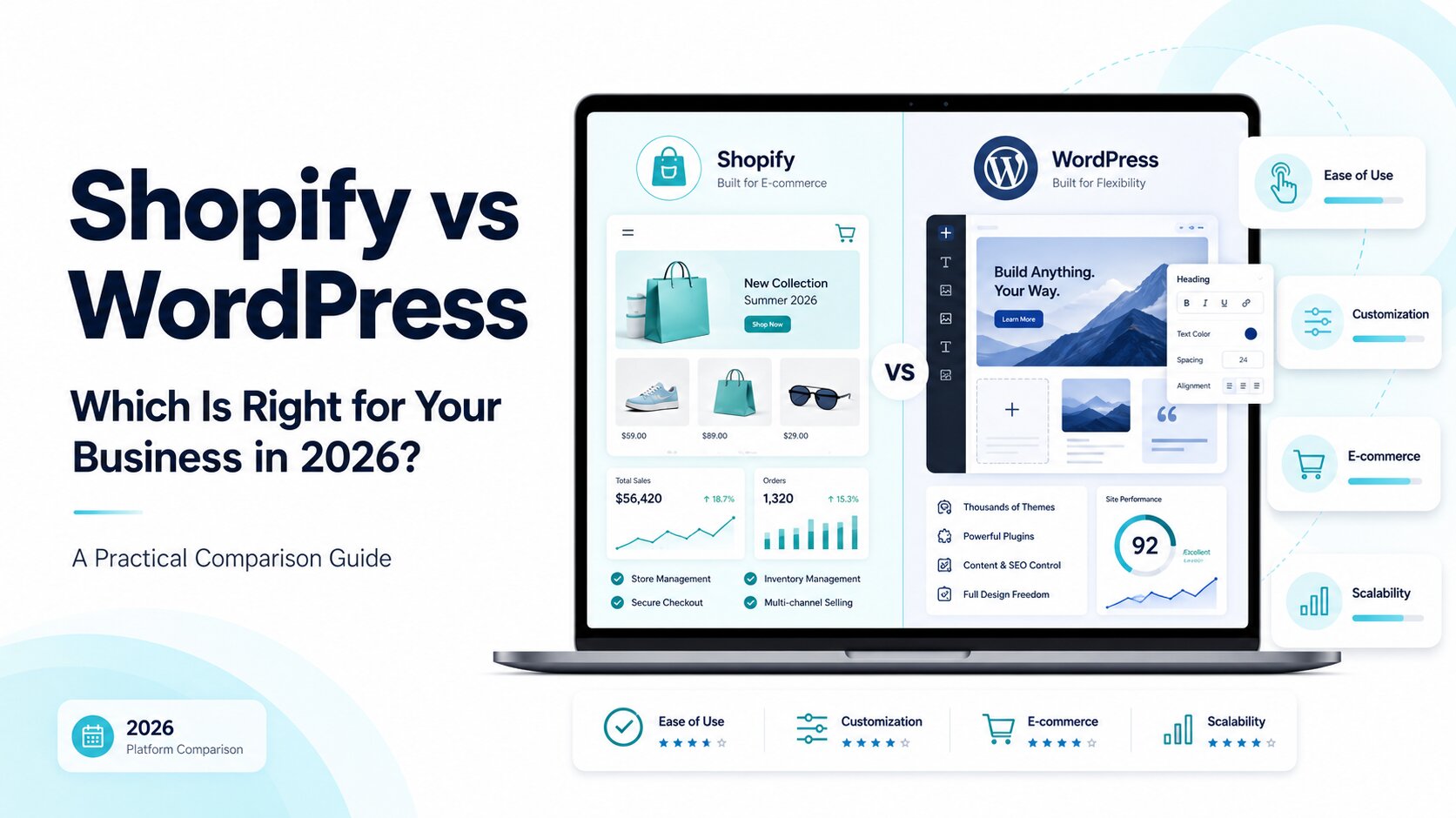
Choosing between Shopify and WordPress is one of the first — and most consequential — decisions a business makes when building a website. Get it right and your site grows easily with you for years. Get it wrong and you’re looking at a costly rebuild down the line.
There’s no universal “better” platform here. The right choice depends on what you’re building, how you plan to manage it, and where you expect to be in two or three years. This guide breaks down the real differences so you can make that call with confidence.
The Short Answer
- Choose Shopify if you’re primarily selling products online and want a platform built specifically for e-commerce, with hosting, security, and checkout handled for you.
- Choose WordPress if you want more flexibility — a blog, a service business site, a membership site, or a store with unusual requirements — and don’t mind a bit more setup.
Now let’s look at why.
What Shopify and WordPress Actually Are
Shopify is a fully hosted e-commerce platform. You pay a monthly subscription, and in return you get hosting, security, payment processing, and a purpose-built store builder, all managed for you. It was built from day one to sell products.
WordPress is open-source software that powers the website itself, but it isn’t hosted for you — you (or your developer) choose hosting separately. WordPress started as a blogging platform and has since grown into a general-purpose website builder used for everything from law firm sites to online stores (usually via a plugin called WooCommerce).
That core difference — “all-in-one platform” versus “flexible, self-managed software” — explains almost every other difference between them.
Cost Comparison
Shopify pricing is predictable: a flat monthly plan (typically starting in the $29–$79/month range for smaller stores, with higher tiers for growing businesses) that includes hosting, security, and support. Transaction fees may apply depending on your payment provider.
WordPress itself is free, but nothing else is. You’ll typically pay separately for:
- Hosting (varies widely based on quality and traffic)
- A premium theme (often a one-time cost)
- Plugins for functionality like SEO, forms, or e-commerce
- A developer, if you want custom design or functionality
For a simple site, WordPress can end up cheaper. For a full-featured online store, the “free” software often comes with more total cost once hosting, plugins, and maintenance are added up — and more of that cost is your own time.
Ease of Use
Shopify is built to be usable without technical knowledge. The dashboard is designed specifically for running a store: adding products, managing inventory, processing orders, and tracking sales all live in one clear interface.
WordPress has a steeper learning curve, especially once you add WooCommerce for selling products. It’s more powerful, but that power comes with more decisions to make and more moving parts to maintain — updates, security patches, and plugin conflicts included.
Design and Flexibility
This is where WordPress pulls ahead. Because it’s open-source, there’s essentially no limit to what can be built — custom layouts, unusual functionality, membership areas, booking systems, multilingual sites, and more. If your business needs something outside the standard mold, WordPress (or a custom build) is usually the better foundation.
Shopify is more constrained by design. Store layouts and functionality are built around selling products efficiently, which is a strength for e-commerce but a limitation if your business needs something Shopify wasn’t built for.
SEO Potential
Both platforms can rank well in search results — SEO success depends far more on content, site structure, and backlinks than on the platform itself. That said, a few technical differences matter:
- WordPress offers more granular control over technical SEO — URL structure, schema markup, page speed optimization, and content types — especially with plugins like Yoast or Rank Math.
- Shopify has improved significantly on SEO fundamentals in recent years, but still has some structural limitations (like less flexible URL control) that matter more for larger content-heavy sites than for straightforward product catalogs.
For a content-driven business — one that plans to publish a lot of blog content, guides, or resources — WordPress generally offers more flexibility. For a product-focused store, Shopify’s built-in SEO tools are usually sufficient.
Scalability
Shopify scales well for growing product catalogs and order volume — the infrastructure is handled for you, so a traffic spike during a sale doesn’t require you to think about servers.
WordPress can scale just as far, but scaling is your responsibility (or your hosting provider’s). A poorly configured WordPress site can slow down significantly under heavy traffic; a well-configured one scales just fine. The difference is that scaling isn’t automatic — it has to be planned for.
Security and Maintenance
Shopify handles security, backups, and platform updates automatically as part of your subscription. There’s very little maintenance burden on your end.
WordPress requires ongoing maintenance — core updates, plugin updates, and security monitoring — either done yourself or through a maintenance plan. Skipping this is one of the most common reasons WordPress sites get compromised.
Quick Comparison
| Quality | Shopify | WordPress |
|---|---|---|
| Best for | Online stores | Any type of website |
| Setup difficulty | Easier | Moderate to advanced |
| Hosting | Included | Separate |
| Monthly cost | Predictable subscription | Variable (hosting + plugins) |
| Design flexibility | Moderate | High |
| Maintenance | Handled for you | Your responsibility |
| SEO control | Good, some limitations | Highly customizable |
Which Should You Choose?
Go with Shopify if:
- Your core business is selling products online
- You want a platform that’s ready to sell out of the box
- You’d rather not manage hosting, security, or updates yourself
Go with WordPress if:
- You need a website that does more than sell products — content, bookings, membership, custom functionality
- You want full control over design and SEO
- You’re comfortable (or working with a team) managing hosting and maintenance
Some businesses use both — a WordPress site for content and brand, with a linked Shopify store for transactions. It’s not an either/or decision if your business genuinely needs both strengths.
Frequently Asked Questions
Can I sell products on WordPress? Yes, through WooCommerce, a free plugin that adds full e-commerce functionality to a WordPress site. It’s a strong option if you want an online store alongside content-heavy pages.
Is Shopify better for SEO than WordPress? Not inherently — WordPress generally offers more technical SEO control, while Shopify offers strong built-in fundamentals with less setup. The bigger factor for rankings is the quality and structure of your content either way.
Can I switch from WordPress to Shopify later, or vice versa? Yes, but migrating a live store or site takes planning to avoid losing SEO rankings and data. It’s easier to choose the right platform upfront than to migrate later.
Braincelo builds on both WordPress and Shopify, matching the platform to your business rather than defaulting to one. If you’re not sure which fits your goals, book a free call and we’ll help you figure xit out.
Found it useful? Pass it along.
 READ
READ  READ
READ  READ
READ